The problem
1Password was scaling fast. Individual contributors were being promoted into management and expected to lead well right away, on teams spread across every time zone in Canada, the US, and the UK.
People Leadership Essentials gave them a shared foundation: six leadership behaviours tied to the company's values. The behaviours came out of a needs analysis that combined surveys, one-on-ones with leaders across departments, and outside research. A founder joined the kickoff.
1Password wrote about the program on its own blog: Leading with honesty: Developing a leadership essentials program. That post tells the story from the People team's side and doesn't name individual team members. This page covers my part: running the program and building the systems underneath it.
Constraints
- Remote-first, every time zone. Managers were spread across Canada, the US, and the UK.
- Don't overwhelm new managers. The program would teach six behaviours, not everything a leader might need.
- Managers live in their calendars, not the LMS. They would join a Zoom call from a calendar invite but wouldn't sign in to the LMS for a live session, so management kept webinars out of the LMS. That left attendance, progress, and points with nowhere to live.
- The LMS was slow to report. Getting survey data out of it took too long.
- One administrator: me.
The program, and the system that ran it
I was the program administrator. Two People-team leaders facilitated the webinars, and the L&D manager decided who was admitted. The rest ran through me:
- Design: ran the needs analysis, did the instructional design with subject-matter experts, and built the eLearning.
- Delivery: scheduled and produced every webinar, running the tech, project work, and breakout rooms. I co-ran the coaching circles and stepped in to facilitate when a facilitator wasn't available.
- Operations: enrolment, learner management, and all program communications.
- Evaluation: built the surveys and assessed how the program was doing.
- Engagement: ran the points contests, and designed and made the awards myself.
The first intake started in October 2023. Each cohort had 12 to 16 managers from different departments. There were two intakes a year, in May and October, with two or three cohorts in each. Every behaviour got its own module, and every module followed the same four-step loop.
Each module
- Prep Self-paced eLearning before the session
- Discuss 1.5-hour live webinar on Zoom
- Apply A week on the job, with a reading or video
- Reflect 1-hour coaching circle
Six modules, one behaviour each · about six months per cohort
- Psychological safety: a team where people speak up and admit mistakes
- Clear expectations for performance and growth
- Feedback that's real-time, actionable, and two-way
- Adapting your style to each person
- Coaching for self-awareness and accountability
- Candid conversations about performance gaps, early
Underneath the program sat a system I built in Notion. Learners worked in tools they already used, while Notion tracked everything behind the scenes and code handled the repetitive admin.
Decisions
Meet managers in their calendars. Live sessions went out as calendar invites with a Zoom link, not as LMS enrolments. The LMS kept the eLearning, which it handled well. The cost was that tracking had to live somewhere else.
Make Notion the system of record. It was the most extensible option and already connected to the company's other tools. Enrolment, attendance, progress, points, and breakout planning all lived there, and I kept refining it from one intake to the next.
Automate anything I'd otherwise do by hand. Slack posts were generated from Notion templates, and breakout rooms were planned in Notion and exported as Zoom's import file. The weekly scoreboard image was drawn in Python with ReportLab. I also championed Articulate's AI tools so we could build and import the eLearning faster.
Make progress visible, and fun. Learners earned points for attendance and finished eLearning, plus bonus points for good ideas in Slack or in a live session. Each cohort ran for three awards:
- Top cohortMost points
- Every learner in the winning cohort got $20 in Bonusly to spend on gift cards.
- Best ParticipantHighest individual score
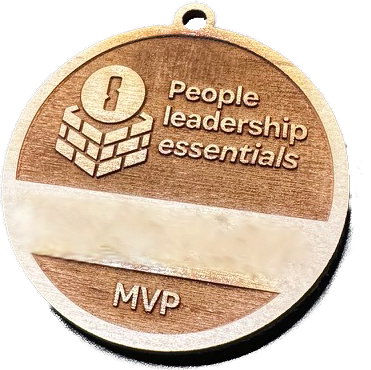
- A laser-cut wooden medal.
- MVPChosen by the facilitators
- For learners who went above and beyond, in and outside the program, and championed it to others. A laser-cut medal and a 3D-printed puzzle box.
What didn't work, and what I changed
The first intake launched without the prep eLearnings, so each webinar had to carry all of its module's content. The sessions ran too intense, with too little time to practise. For later intakes I built the prep eLearnings, we cut webinar content back to make room for exercises, and the program moved toward a flipped classroom: learn alone first, then use the live time to practise together.
The surveys didn't scale. In the first intake, our survey platform meant building a new survey for every module. That was tedious, and it made results slow to analyze and hard to compare between modules. I rebuilt it in Google Forms as one consistent survey reused for every module, with the analysis set up in advance in a dashboard. Leadership could see results as they came in, and survey prep took about half the time.
Fallbacks were built in. If a facilitator couldn't make a session, I stepped in, because I had produced every session and knew the material. If a learner fell behind, they could ask where they stood, and a Notion formula produced an exact list of what they still had to finish.
Results
About 150 managers went through the program by the time I left 1Password in May 2026.
1Password published survey results in November 2024. Here they are placed on the Kirkpatrick model, the standard four levels for evaluating training:
-
Level 1Reaction
Current learners who found the content relevant to their daily work
89% -
Level 2Learning
Alumni who felt more knowledgeable about the six behaviours
100% -
Level 3Behaviour
Alumni who said they now show the behaviours more consistently at work
80% -
Level 4Results
Business impact, managers who were promoted after the program completed
40+
All three published numbers are self-reported. Alongside them, the survey rebuild cut prep time by about half and gave leadership a live view of results.
What I'd do next time
- More interaction in the live sessions, so the time together goes to practice rather than presentation.
- Just-in-time support on the job: short resources a manager can pull up at the moment they need them, such as right before a difficult conversation.
- Design for the facilitators, not just the learners. A flipped classroom asks facilitators to guide more and present less. Ours were most at home in a traditional, presentation-led style, so the live sessions stayed closer to that than the design intended. Next time I'd give facilitators the same support I gave learners, so a new format feels as natural to run as a familiar one.